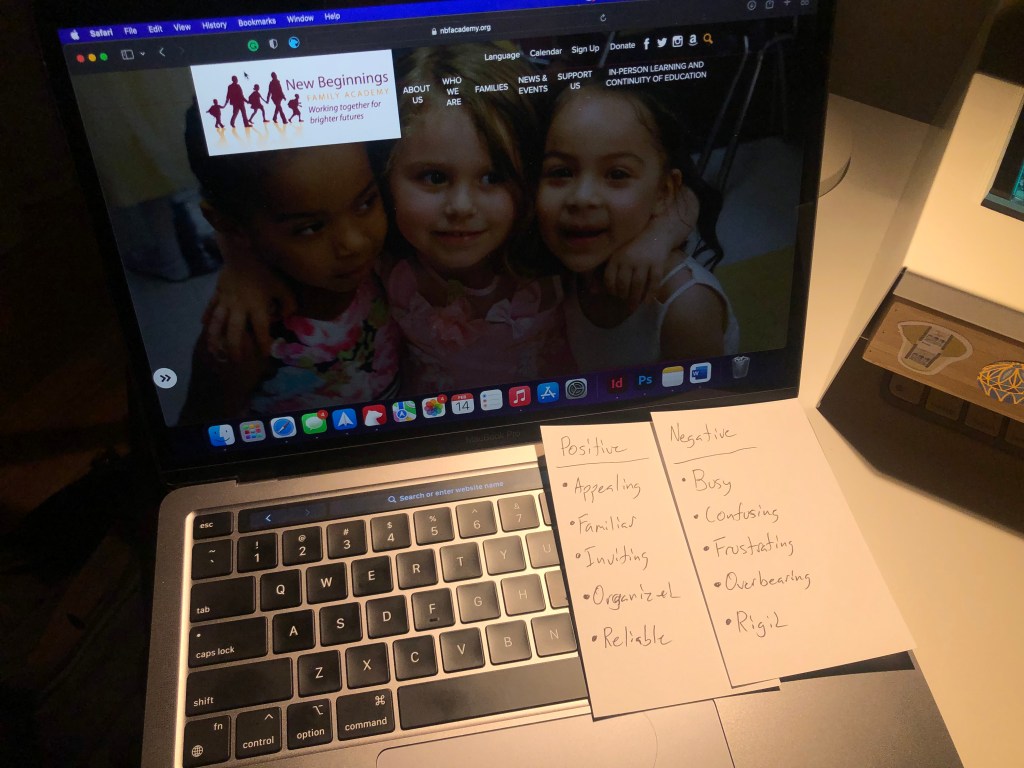
In understanding user experience research methods, several different methods are available to use. What matters most is finding the right research method that will aid your research for your study.
One research method that is worth highlighting is the desirability studies method. In UX Methods: A Quick Guide to User Experience Research Methods, associate professor in interactive design James Pannafino and UX architect Patrick McNeil describe desirability studies as “when variations of visual designs are shown a participant and they are asked to make an association from a word list so that a better understanding of emotional response can be understood,” (Pannafino & McNeil, 30). To help understand the emotional connection users have to a design, this method allows for users to give feedback by linking different works to the different designs. This method is especially important when several different designs are on the table, to help pin down which design promotes the most positive emotions in the users.
The desirability study was first introduced by Joey Benedek and Trish Miner in their study Measuring Desirability: New methods for evaluating desirability in a usability lab setting. In the study, Benedek and Miner created 118 cards with product reaction words on them. From there, users used the cards to select five words that describe the product. The words range from positive adjectives, like accessible and sophisticated, to negative, slow and unattractive (Moran).
To start, write out a list of adjectives that can be used to describe the emotions of the design. Categorize them by positive and negative emotions, then print out the list. Make sure there are plenty of words for the users to connect to.
Next, display the different designs for each of the users to review. Then, ask the users to review each of the different designs and pick words that they connect with each design.
Observe the participants as they complete the exercise, then collect the results. From there, analyze the results to spot different patterns of what words the users connect with the designs.
This method does not require a lot of tools to complete, just some paper for the users to connect the words to the designs. It will require some time, as users need not be rushed to fully connect the words to the designs. Ensure you give each user the time they need to conduct the study appropriately.
One example of the use of desirability studies comes from the Nielsen Norman Group, which did a study on whether young adults appreciate flat user interfaces more than older adults. In the study, users were given a survey to rate the attractiveness on a scale from one to five and asked to describe a series of screenshots by selecting five words from a word list. The survey found that young adults appreciate the flat user interface more than older adults. As well, for the control design, the word choices from the desirability studies were nearly identical between the younger and older adults (Moran).
Another example of a desirability study comes from Yahoo! Personals, to test some different designs to see which option was the best direction. The users were given a set of index cards and asked to connect which words from the index cards go best with each design. After making a choice, the researcher would ask why the user made that selection. The study was important as it gave researchers the qualitative data they needed to make a necessary change to have their product be more desirable compared to their competitors (Rohrer).
For New Beginnings Family Academy’s website, desirability studies can be crucial for analyzing how the website design emotionally affects users. Given that there are different types of users to the website, this also allows learning what specific emotions different users feel about a certain design.
When it comes to user experience, emotion is a key factor to help well a design will do. If the design is not well thought out, the design can alienate users and push them off your website. If the design has connections to positive adjectives, then it is instilling confidence in the users who will come back.
Desirability studies also give important feedback to designers on efforts they can do to improve a design. If they find a design applying and inviting but at times confusing, designers can work to amend that issue so the users are left with positive emotions.
Sources Cited:
Moran, K. (2016, February 28). Using the Microsoft Desirability Toolkit to Test Visual appeal. Nielsen Norman Group. Retrieved February 14, 2022, from https://www.nngroup.com/articles/microsoft-desirability-toolkit/
Moran, K. (2016, February 28). Young adults appreciate flat design more than their parents do. Nielsen Norman Group. Retrieved February 14, 2022, from https://www.nngroup.com/articles/young-adults-flat-design/
Moran, K. (2016, March 14). Microsoft Desirability Toolkit Product Reaction Words. Nielsen Norman Group. Retrieved February 14, 2022, from https://www.nngroup.com/articles/desirability-reaction-words/
Pannafino, J., & McNeil, P. (2017). Ux methods: A quick guide to user experience research methods. CDUXP.
Rohrer, C. (2018, September 24). Desirability studies: Measuring aesthetic response to visual designs. XDStrategy. Retrieved February 14, 2022, from https://www.xdstrategy.com/desirability-studies/
 Bailey MeCey
Leave a comment