Summary
As we continue learning different styles of animation, we move on to how animation can be used for promotion. One of those ways is a logo stinger, which adds movement and personality to a logo. Before creating the logo stinger, I read on how to find the best technique for your animation, and the principles to create a strong animation. Then, I researched different animations that incorporate these principles.
Reading & Writing
For this module, the reading focused on finding the right technique for your animation. In Animated Storytelling, Liz Blazer covers a variety of animation techniques and the outcomes for each of them. It’s important to find the right technique for your animation, as it has the power to enhance the impact of your animation. In the same vein, choosing the wrong technique can take away from that same impact.
The animation technique needs to be the best one for expressing your story. It’s also important to keep in mind the technique in how your project will be viewed by the audience. Whether that’s on an iPhone or the big screen, it’s important to keep in mind the format.
The types of animation techniques include:
Hand Drawn – Animation created by hand, most can range from cel animation to rotoscoping.
2D Stop Motion – Using a camera to take photos on a flat surface.
3D Stop Motion – Using a camera to take photos on a set. Can use modeling clay or puppets.
2D CGI – Animation created using 2D software.
3D CGI – Using 3D software to create animation in a virtual space.
Understanding your animation technique is also understanding your capabilities. While we might dream big, sometimes we are technically limited to create an animation. If that is the case, it’s important to adapt your technique. That might mean using a 3D animation to mimic a 2D animation technique, or converting photos to feel like fluid animation. Another way to adapt is to bring in a team that knows how to execute your animation technique. While this will require some extra funds, it is worth it if you want the job done right.
Research
To help aid the creation of the logo stinger, I researched a collection of animations that employ the 12 Principles of Animation. These principles, introduced by Disney animators Ollie Johnson and Frank Thomas, are regarded as the key to producing realistic animations.
Squash and Stretch
The Squash and Stretch principle follows that an object reacts to show malleability. In this animation, the ball stretches and it falls and squashes as it hits the ground.
Anticipation / Timing
In Disney’s Pinocchio, one of the more disturbing scenes is when Lampwick transforms into a donkey. As the donkey Lampwick kicks, his body moves down and his legs rear up to help the audience anticipate the action. Also, to help express the panic and terror of the situation, there are fewer frames of animation to make the timing feel very fast.
Staging
The Simpsons Itchy and Scratchy Show uses a lot of animation techniques, and in particular staging. In this animation, there is a clear way the frame is staged to help the audience follow the action. The characters are in the center of the frame, and the action is given space for the audience to take in. Each action does not overlap over the other, in a way that would be difficult for the audience to follow. Given that this is a cartoon inside of a cartoon, it is even more important to follow proper staging to not confuse the viewer.
Slow In and Slow Out
Flashback, a 1992 video game developed for the Amiga computer, was known for its rotoscoped animation style. In the introduction, as the main character is escaping from a facility, he hops onto a hoverbike. As the bike lifts off, the animation frames are slowed down. Then, to show the bike is picking up speed, the animation frames are quick as the bike warps out of frame.
Appeal
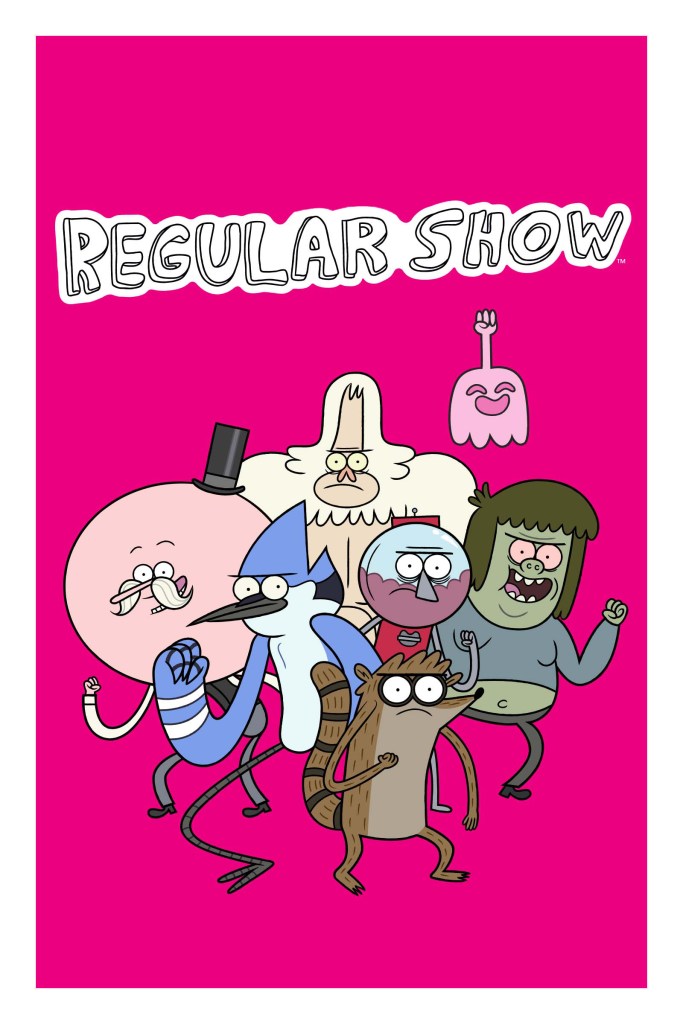
A good variety of characters are important for animation, as too many of the same type will bore the audience. Each of the main characters on the cartoon Regular Show has its body type and dimensions, from the tall and lanky bird Mordecai to the short and squat raccoon Rigby. Mordecai and Rigby are drawn with likable characteristics to help connect them to the audience, while their antagonist boss Benson is drawn to be angrier and mean to emphasize their conflict.
Create
For this week’s assignment, the goal was to create an animated logo stinger. For my logo, I used a previous concept I created for an independent video game publisher called Simple Digital.
For my animation, I followed the Squash and Stretch animation principle. Using the circular logo, I animated it to drop down, bounce, and come back up to the center of the screen. When it hits the bottom of the frame, it squashes down before coming back to normal. I also included a bounce sound effect to emphasize the squash.
After coming to the center of the screen, the logo then shifts to the right as the name of the company animates from the left side. To give both layers a sense of speed, I included motion blurs. Once both are in the frame, I added the audio of myself saying Simple Digital to make it feel more professional.
 Bailey MeCey
Leave a comment