Summary
To conclude this class, the goal was to create a mini-documentary on a subject of our choice. We would shoot and edit the video and do any post-production work. To help guide the project, I read on how to edit and research different editing techniques.
Reading & Writing
The end of The Bare Bones Camera Course for Film and Video concludes with some final tips for your video production. Given that the book is teaching the basic foundations for video production, it emphasizes the importance of sticking to the foundations. From there, you can break the rules to make your work stand out. However, it’s important to understand the rules before you break them. Other necessary aspects of production are learning to welcome criticism and analyzing what worked to do that in the future. Even the best productions can be improved, and it’s easy to learn for the future.
Overall, the book is a fantastic foundation for video production. I focused on video journalism in my undergrad, so this was more of a refresher for me. However, given that it’s been some time since I’ve done dedicated video production it was good to go back to. The most useful concept I learned was in the lighting section and how to best light a scene. While light seems the same, how you light a scene interiorly versus exteriorly is important to consider. I hope to spend more time learning screen direction and how to best implement it for productions.
Research to Inform
To help inform the editing process, I researched different editing techniques. The most popular editing techniques are the J and L cut. The J cut is where the audio comes before the video in the cut, while the L cut is where the video comes in before the audio in the cut.
An example of a J cut can be found in the film Baby Driver. Later on in the film, two characters are conversing when the protagonist Baby looks up and we hear the sound of a car pulling up and honking. It then cuts to his girlfriend exiting the diner. By overlaying the audio of the car pulling up and honking, it transitions the scene in a fast and fluid way.
An example of the L cut can be found in the classic Spielberg film Jurassic Park. In the scene, the two children are being attacked by a T. Rex in the tour car. As the T.Rex slams his head on the roof window, the window caves in and the children scream. As the scene cuts, the visuals are of Alan Grant and Ian Malcolm but the audio of the screaming continues. It creates a terrifying feeling as these characters watch this attack happen.
What’s amazing is how these two cuts can produce entirely different effects. The L cut in Jurassic Park creates an emotional effect, while the J cut in Baby Driver is used to move the story along in a quick way.
Create
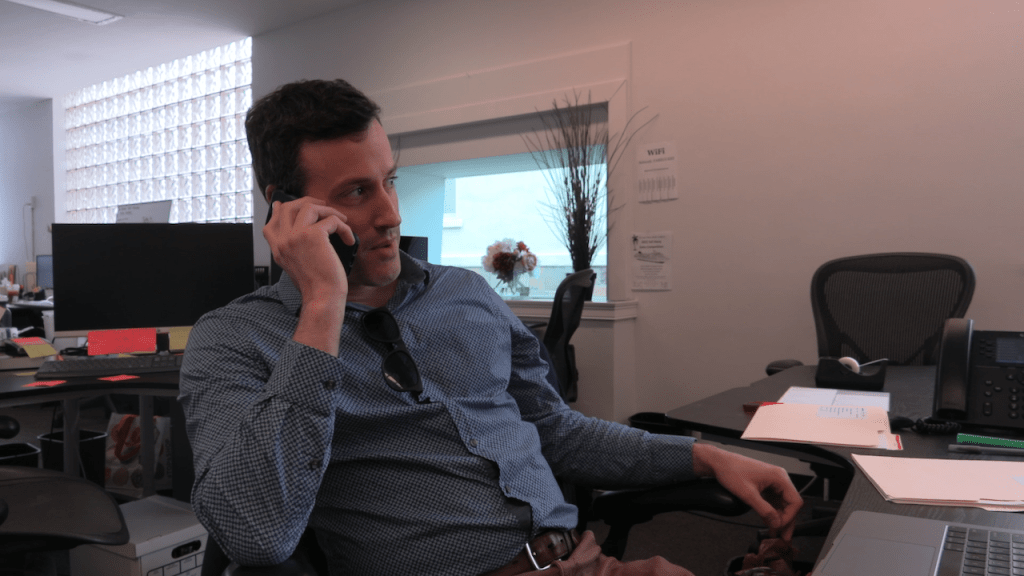
For this module, I created a mini-documentary on Zak Kampton, a real estate agent I work with. Zak has an incredible story of struggling with drug and alcohol addiction to becoming a top agent at the Farnam Realty Group. One aspect of the project I am disappointed by is lacking b-roll to fully tell the story. I tried to get some photos from Zak to help add to the visuals, but I wasn’t able to get them. Overall I’m proud of what I created and hope to do more projects like this in the future.
Works Cited
Schroeppel, T. (2018). The Bare Bones Camera Course for Film and Video. Langara College.
 Bailey MeCey
Leave a comment