Compared to other peers my age, I’m a late-stage Boomer when it comes to social media. I never use my personal Facebook, haven’t posted on Instagram in months and only have Snapchat installed on my phone for an occasional group chat with college buddies. The only social media I regularly use is Twitter, as I have constructed it around my interests. I primarily follow those in the video games industry, politics and comedy, and like to browse Twitter throughout the day. Sometimes when I can not sleep, I’ll just sit in bed and scroll through posts for hours. I have tried to limit myself before, but usually ends up with me removing the blockers after a day or two and returning to the endless barrage of tweets.
The Plan:
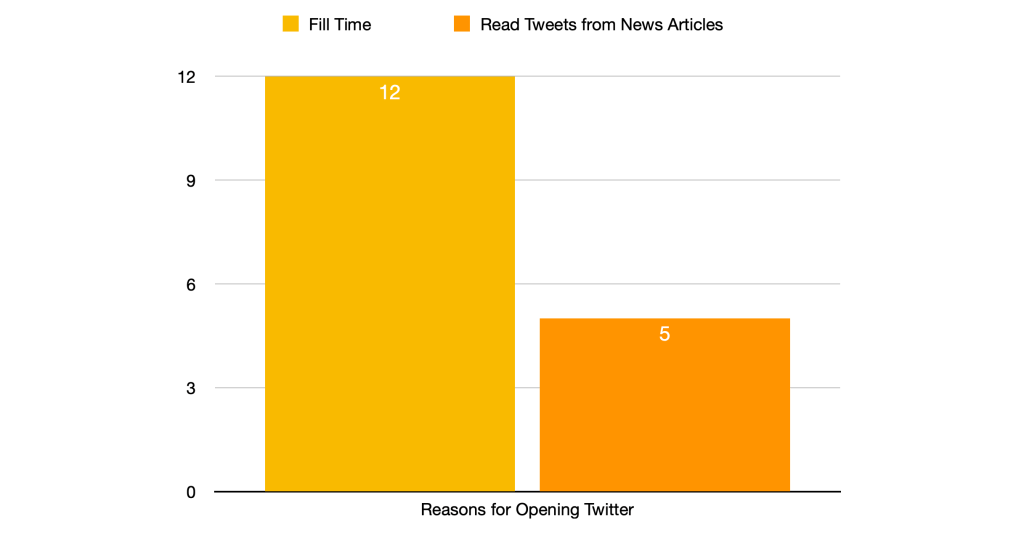
However, this time will be different. For this digital detox, I decided to forgo the use of Twitter for five days. From there, I would keep track of how many times I went onto Twitter during the detox, what I was thinking about doing when I went on there and for how long I was on for. During my period of detox I went onto Twitter a total of 17 times. The breakdown of the period includes:
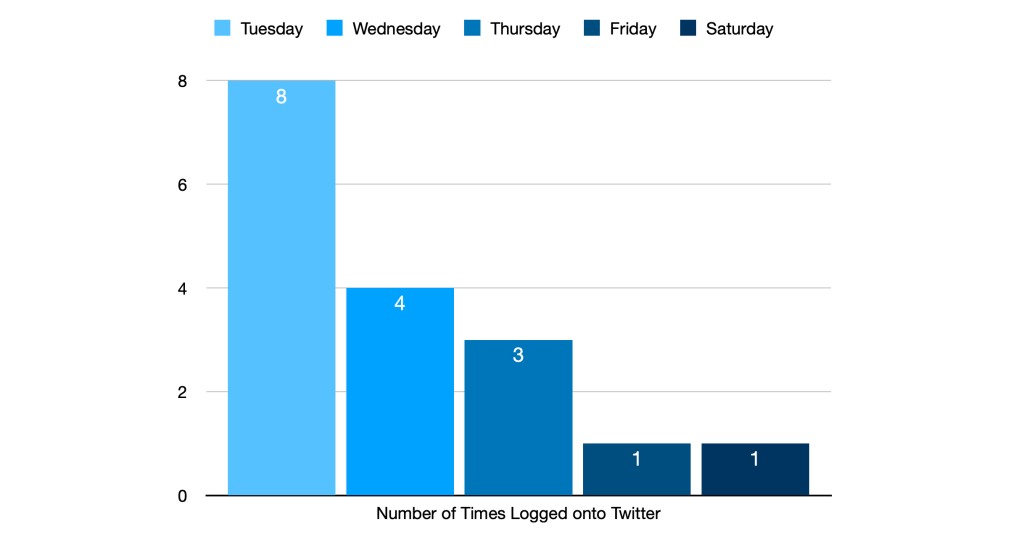
When I started the detox, I decided to keep the Twitter app on my phone and keep all shortcuts on my computer to see what would happen. I found that with Twitter easily accessible, I would still go to the site out of habit. This primarily happened when I was looking to fill time, whether I was waiting for lunch to heat in the microwave or uploading photos on a project at work. As soon as I would open Twitter I would catch myself and immediately close the app.
The next day, I decided to try to improve my detox by removing the Twitter app and any shortcuts on my computer completely. After that, it was immensely easier to disconnect after making it an extra step to get onto Twitter to break the habit. Doing this, I halted the number of times I tried to go onto Twitter. I also decided to pick up a hobby that I have never done before; comic books. I downloaded an app that lets you read comic books from your phone, so instead of scrolling through Twitter for 20 minutes I would read a chapter of a graphic novel. In just five days, I read 12 different comic books, and feel like it was a more enjoyable use of my time than spending it on Twitter. Instead of scrolling through Twitter for a couple hours during the day and right before bed, I was engaging in an activity that was new yet more engaging than before. Setting up roadblocks to keep me from reverting to old habits and finding in ways to spend my free time improved my ability to stay off Twitter.
In addition, not having that nagging feeling to check Twitter was a major plus to my work performance. In Cal Newport’s book Deep Work, Newport focuses on a concept he formulates called Deep Work, which involves working on intensive tasks that push your abilities in a distraction-free environment. Distractions keeping us from reaching a state of Deep Work could include working in an open office where people are constantly running around, or a never-ending ping of new emails. For me, Twitter was a distraction a lot of the times keeping me from focusing on tasks. It was not that I was only on Twitter at work, but almost every hour I would end with a 5-10 minute break on Twitter. Now that I was not on Twitter, I felt I was able to focus on tasks easier and not feel the constant nag to check to see new updates.
Over the course of the detox, I also found how I was interacting with Twitter changing. At the beginning I was going onto Twitter to fill time and scroll, but later on I was running into tweets that were embedded into news stories. Instead of realizing I was looking at Twitter and closing out, I found I would view the tweet to see how it adds to the story I was reading, then close it after. Even though I was on Twitter, I never felt the need to scroll through more.
Avoiding the Stream and Doomscroll
Speaking of scrolling, deleting Twitter helped me to avoid what Hossein Derakhshan in his article The Web We Have to Save as “The Stream”. “The Stream” is the continuous set of information that social media sites like Twitter implement to keep users logged in. The information streams are set up through algorithms to keep users flowing through them and never jumping out. When I would read a comic book instead of browse Twitter, they would come to an end and I could move on to something else, but with Twitter the tweets keep coming.
This is even more so now in the age of the doomscroll. For those not aware, doomscrolling is when we scroll through social media and news sites reading bad news. With the ongoing coronavirus pandemic, civil unrest across the country and and more, I would find myself reading these stories for all hours of the night. In the article Your ‘Doomscrolling’ Breeds Anxiety. Here’s How To Stop The Cycle, Lulu Garcia-Navarro discusses the topic of doomscrolling and breaks down tips to help improve your mental health. Garcia-Navarro brings up great tips like setting up a timer to limit scrolling and making room for more positive content, I found that setting up a wall between myself and Twitter has improved my mental health immensely. Even though it has been small given it has been just five days, I do not have that urge to stay up at night dreading what I will see online.
Conclusion:
Now that I have come to the end of my digital detox, I feel more in control of my social media habits when it comes to Twitter. Before there was always a nag to check and see if I was missing out on some important news or a funny joke, but now I know that I just don’t need to have it open 24/7. I will not stop myself from checking in every now and then, but I will not add the Twitter app back onto my phone. I know that I will want to sometimes log in and see an important news update, but not having the ease to get stuck in the scroll will help immensely with keeping Twitter from becoming a major focus of my time.
References:
Newport, C. (2016). Introduction and Chapter 1: Deep Work Is Valuable. In Deep Work: Rules for Focused Success in a Distracted World (pp. 1-48). New York, NY: Grand Central Publishing.
Derakhshan, H. (2019, September 12). The Web We Have to Save. Retrieved September 13, 2020, from https://medium.com/matter/the-web-we-have-to-save-2eb1fe15a426
Garcia-Navarro, L. (2020, July 19). Your ‘Doomscrolling’ Breeds Anxiety. Here’s How To Stop The Cycle. Retrieved September 13, 2020, from https://www.npr.org/2020/07/19/892728595/your-doomscrolling-breeds-anxiety-here-s-how-to-stop-the-cycle
 Bailey MeCey
Leave a comment